
Exile as a "Nourishing" Force
By Pedro Manuel González Reinoso/Cubanet
SANTA CLARA.— Lázaro Jesús González (b. 1990) has been living in Miami for two years. He graduated with a degree in Journalism from the University of Havana’s School of Communication in 2014, and subsequently attended several creative workshops at the International Film and Television School in San Antonio de los Baños.
For his undergraduate thesis, he proposed Máscaras (Masks), a two-person documentary exploring the art of drag in Cuba—a work that showcased a theme that would become recurrent in his future oeuvre: the tenuous resistance of the LGBTIQ community against the hyper-masculine context of the island. It was a project for which he received a distinguished grade.

How was your vocation for cinema born?
I believe it stemmed from a need for greater freedom—perhaps also an act of tenacity in the face of the rigid constraints of journalism. Before entering university—while finishing high school in my native Pinar del Río—my vocation was to be a writer; at that time, there were only two elective majors available to me: Journalism or Philology.
From the solitude of the countryside where I was born, literature became my ultimate refuge—my true lifeline—until I arrived in Havana and discovered other possibilities for expression. During those years of guajiro—or country boy—dazzlement with the cultural life of the big city (on such a tiny island), theater played a fundamental role. Shortly thereafter, I found myself increasingly absorbed by the pleasure of the darkened theater—like an exorcism (à la Cabrera Infante) and an escape from reality.
Inside the Chaplin Theater, a student hailing from the provinces—who could barely scrape together enough money for a decent lunch—would forget his hunger while watching film series featuring the best cinema from every corner of the globe... and in this way, I was saved.
I believe that even the tragic fate of the elevator at F and 3rd Street—my student residence for five years—helped define my interests. If you live on the 20th floor and the elevator is almost always broken, you have to find something useful to do with your time before going to sleep.
And, most definitely, the shadows were my accomplices. Especially those found at that corner of 23rd and 12th Street, alongside the cheap pizzas from Cinecitá. I believe that the need to consume is what makes a filmmaker: first, by devouring works as if it were an imperative; and subsequently, by gradually learning how to draw sustenance from them—finding ways to play at being a creator without perishing in the attempt.
In my case, there is a factor I must not overlook: the education I gained through criticism and research—avenues I was able to explore using the tools of journalism.
I was able to publish on various cultural platforms while I was a student, thereby earning some compensation (which was a welcome relief for someone living off his mother’s support); but above all, this allowed me to specialize within the arts sector. It was yet another way for me to approach filmmaking—much as renowned figures like Truffaut or Godard had done before me.
Although I feel that certain professional circles in Cuba tend to fuel prejudices regarding this matter—viewing such duality as something strange or anomalous—I personally transitioned from one medium of expression to the other without any trauma. When I am conceptualizing a story, I have absolutely no qualms about adopting aesthetic approaches that lean closer to journalism; ultimately, the exhibition channels themselves will be what define the final product.
Essentially, the documentaries I have produced have not enjoyed the kind of television exposure in Cuba that is typically granted to the apologetic works of the official press. Instead, they have been marginalized—much like the majority of productions created by young filmmakers—relegated to small-scale showcases, "ghost screenings," or—what is perhaps most troubling of all—achieving significant impact and recognition exclusively outside the country.
Did your previous works influence your decision to continue focusing on LGBTQ+ themes?
Undoubtedly, the body of work exploring LGBTQ+ culture—which comprises the trilogy Margot, Máscaras, and Villa Rosa—has profoundly shaped my ideological and aesthetic interests. I have no fear of being pigeonholed within the realm of queer cinema (or cine cuir—to use the Hispanized term) so long as I feel there are still stories within that space left to be told. Some have criticized me with questions such as: “How long are you going to keep making works about birds, now that Mariela Castro has officially normalized being gay?”... or have accused me of being apolitical for not focusing on well-worn topics like poverty, housing, transportation, or any other macro-issue.
How much of that stems from your identity as a gay man?
I insist on defining myself as a queer filmmaker. I am interested in continuing to explore this subject matter—and not solely because I am gay. I feel that much of our LGBTIQ memory remains scattered; that is why my projects to date have revolved around it. And, curiously, each project has paved the way for the next, for in each instance, I have come to realize just how profound the voids still are—even in these “times of change.” Furthermore, I suppose it is impossible to possess a gay sensibility without channeling it into a form of activism—though an activism expressed through art, rather than one intended to fuel political crusades.
I also view this as a generational commitment; I believe it falls to us to listen to and learn from the experiences of those who came before us. As Eloy Guzmán once expressed to me—speaking from his perspective as a Cuban “sexile”: “We must speak about this, so that others do not have to suffer what we suffered.”
This apparent normalization is all the more dangerous because it conceals the administration of history—a Machiavellian vanishing point designed to incite us to look the other way. It is a task that CENESEX fulfills programmatically, and which, consequently, compels me to seek out those facets of history that have been silenced by the institutional establishment.
Each subject I investigated led me to another; thus, I do not conceive of filmmaking as a commissioned assignment. Nor do I aspire to serve any agenda whatsoever. It has been my own lack of knowledge—and my desire to inquire—that has served as the driving force behind every story I have told.
Along the way, I have come to discover that there remains much to be unearthed. For instance, if such openness truly exists, why is there no discussion regarding the UMAP camps or the Mariel exodus? Are they ever even mentioned in history classes? Or why does Conducta Impropia (Improper Conduct) fail to appear in anthologies of Cuban cinema published on the Island?
These are absent pages of history; consequently, individuals are formed who are devoid of memory—or who exist amidst vast historical lacunae.
It is curious that, having been born ten years after the largest mass expatriation in history, I remained entirely unaware of it until much later. To a significant degree, I have managed to attain a more holistic perspective on what transpired thanks to my interactions with the diaspora; for from within the country, it would have been exceedingly difficult to reconstruct the actual events.
Consider, for example, that the aforementioned documentary—which contains invaluable testimonies—as well as Reinaldo Arenas’s own autobiography, remain officially banned. Furthermore, many of the documents that might be required for such research are either inaccessible or have simply vanished.
I would not waste my time attempting to compile the police summonses that compelled thousands of people to leave Cuba simply for being “different”; nor would I attempt to secure permission to rummage through the audiovisual archives of the FAR (Revolutionary Armed Forces) Film Studios in search of revealing footage. Obviously, everything one seeks must be found on this side—among whatever materials the survivors of that era managed to safeguard. Although—who knows?—perhaps one day, amidst Mariela Castro’s packed schedule, a space might open up to address these pending matters and provide answers to long-standing questions, offering precise figures at last.
On Sexilio—Your Current Endeavor...
All the difficulties involved actually make working on this project—titled Sexilio—even more gratifying for me; this holds true even though it yields no financial gain—indeed, it comes entirely out of my own pocket—as I pursue a concept originally coined by the academic Manolo Guzmán to describe queer migration.
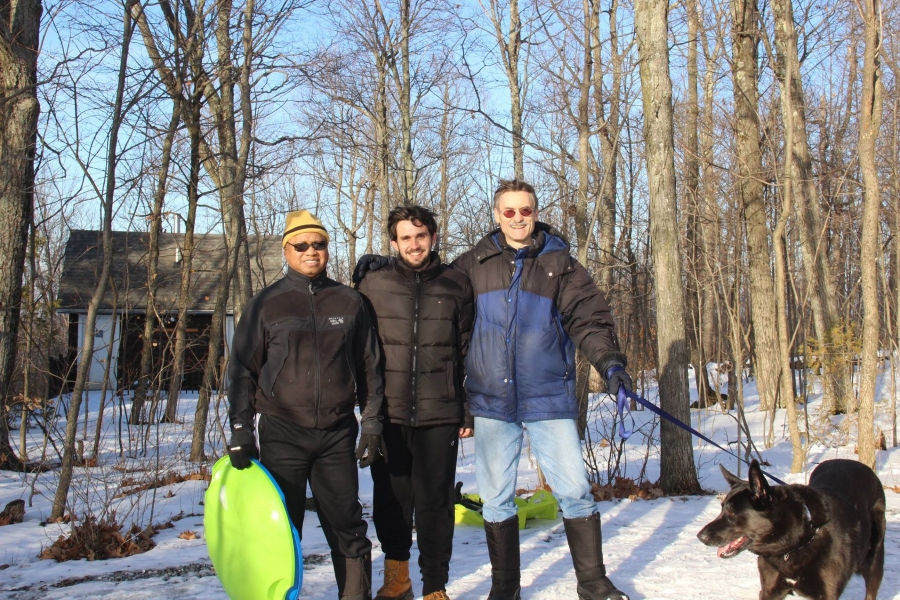
The starting point for this journey was meeting Eloy Guzmán—a marielito (Mariel boatlift refugee) whose surname happens to be a pure coincidence with that of Manolo Guzmán—who currently resides in Vermont and is in the process of writing his memoirs. His research process—running parallel to my own—will serve as the central organizing axis of the film’s narrative. As for my motivations, I believe the fundamental driving force was observing how Eloy managed to find happiness despite the profound sense of uprooting he experienced; this served as the catalyst that inspired me to venture out and seek other individuals with similar stories. I aim to highlight the great irony inherent in Machiavellian power structures: in their very attempt to destroy "undesirable subjects," they inadvertently end up improving those individuals' lives.
And on this specific point, a number of people expelled from Cuba in 1980—whether directly or indirectly—tend to find common ground: they were cast out for deviating from heteronormative standards.
In other words, I am interested in showcasing Caribbean empowerment as it is interwoven within North American culture and society, thereby dispelling certain prevailing stereotypes regarding marielitos—stereotypes that persist on both sides of the divide.
There is, of course, a profound underlying tragedy that cannot be overlooked; however, I wish to place greater emphasis on individual resilience—specifically, the types of identities that Cuban emigrants have successfully asserted, and how they have emerged as survivors of a form of genocide that, while leaving them deeply scarred, simultaneously enabled them to achieve self-realization.
My subjects are scattered across various cities, including Burlington, San Francisco, New York, and—naturally—Miami. Some are former teachers who were barred from practicing their profession in their home country under the restrictive "parametrization" policies, yet went on to serve as educators here until the very end of their careers.
Others achieved open and resounding success in the art of drag performance—having honed their craft in secret, underground spaces back home—or seized the opportunity to undergo gender-affirming surgery and subsequently emerge as pivotal figures within the queer-Latino activist movement in the United States. There are musicians, painters, writers, and figures from the modeling world who were part of this history—and who can still reveal to us their courageous experiences.
Each of them—along with those who may emerge along the way—will be essential to this circumnavigation of the Cuban diaspora’s identity; a journey in which I myself feel like a central figure, serving as an interlocutor with that past that weighs so heavily on my mind, both as an artist and as a gay man. Furthermore, I am interested in highlighting other threads of identity that interconnect these witnesses—going beyond merely pointing out a common oppressor.
As I have progressed in this investigative endeavor, I have come to feel that an entire LGBTIQ generation—along with its cultural touchstones and social concerns—was uprooted wholesale the moment they departed from the port of Havana, only to blossom on the other side of the sea, far from ever fading away.
It is as if the bolero had been erased to make way for reggaetón—until a truly fierce "queen" came along to rescue it, lip-syncing to the likes of Olga Guillot or La Lupe. At the same time, I have witnessed how that sluice gate proved to be a blessing for many of the national “outsiders”—those fed up with the persecutions and other atrocities for which the government has yet to offer a single apology to this day.
That is why I believe we must fight against amnesia: to find ourselves once again.
This will be my next contribution to Sexilio.
(Original interviews was published at https://www.cubanet.org/el-exilio-como-fuente-nutricia/)




Comments